Nano Banana 2.1 vs GPT Image 2.5: Full Comparison & Free Online Test
Compare Nano Banana 2.1 vs GPT Image 2.5 with verified 4K image benchmarks, text accuracy, prompt tests, and cost breakdowns. Test Nano Banana 2.1 online free.

When Google officially launched Nano Banana 2.1 on October 6, 2026, and OpenAI introduced GPT Image 2.5 (split into Flare and Sunburst models), generative vision entered its most practical phase.
For commercial creators, media buyers, and software teams, marketing superlatives no longer matter. What matters is which model holds a product label steady, which one spells an ad headline correctly, and which one does not double your monthly cloud bill on failed attempts.
In this head-to-head evaluation of nano banana 2.1 vs gpt image 2.5, we compare both flagship engines across real image prompts, side-by-side visual samples, published API rate cards, and documented engineering limits.
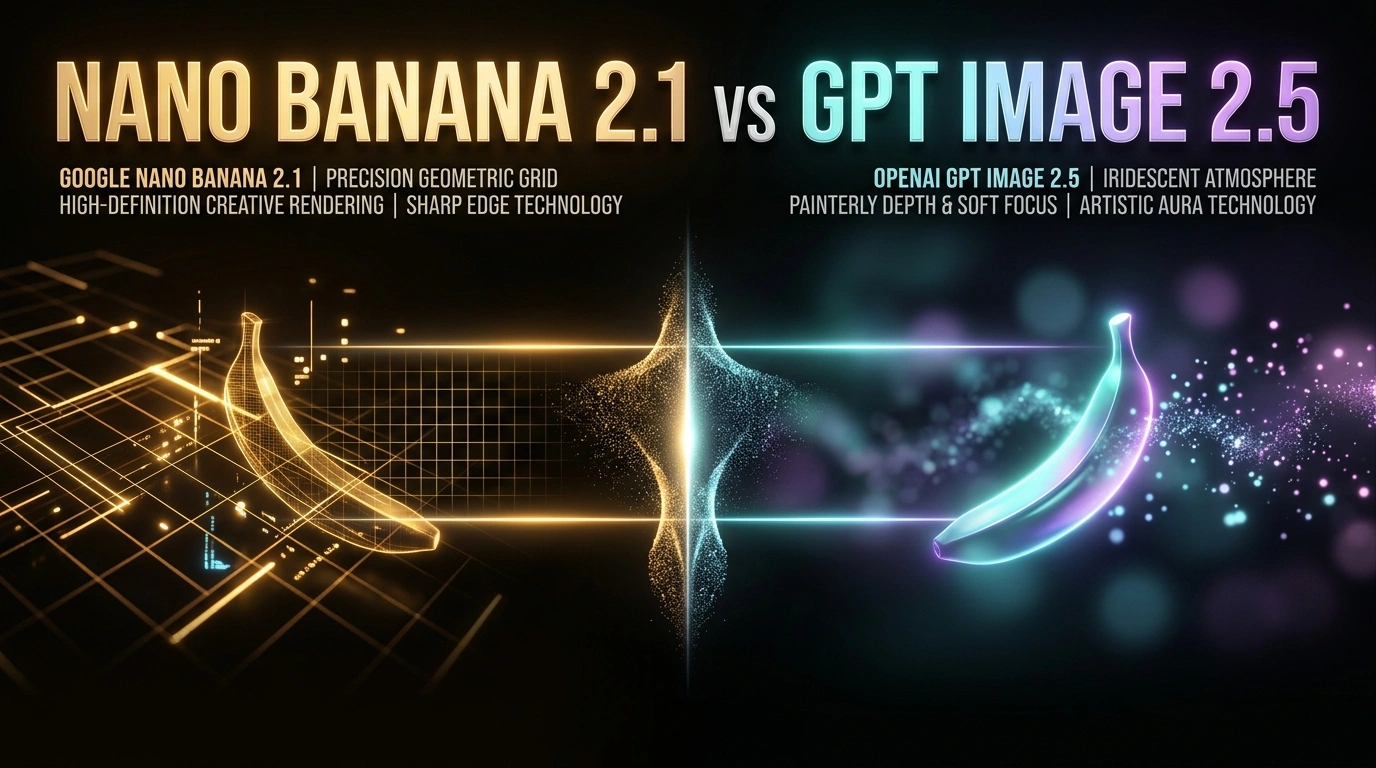 Figure 0: Google's multimodal Flash-speed engine Nano Banana 2.1 compared directly with OpenAI's GPT Image 2.5 creative architecture.
The 30-Second Executive Verdict
Neither engine sweeps the board. The selection between nano banana 2.1 vs gpt image 2.5 comes down to three clear workflow divides:
- Pick Nano Banana 2.1 for Commercial Catalog & Marketing Production: It delivers vector-crisp typography, locks logos across up to 14 reference photos, supports 8:1 panoramic banners without tiling seams, and slashes API generation costs by approximately 50%.
- Pick GPT Image 2.5 for Native Transparency & Painterly Atmosphere: It generates native transparent background PNGs out of the box and maintains subtle painterly lighting nuances in creative editorial concepts.
- Run your own test before committing: You can test prompts on Google's new model directly using our floating trial bar at the bottom of this page—no credit card required.
The Parameter & Cost Breakdown
Figures below reflect official vendor documentation: Google's gemini-nano-banana-2.1 model card and Gemini API rate card, alongside OpenAI's published developer reference for GPT Image 2.5 (verified October 2026).
| Technical Specification | Google Nano Banana 2.1 (gemini-nano-banana-2.1) | OpenAI GPT Image 2.5 (Flare / Sunburst) |
|---|---|---|
| Release Date | October 6, 2026 (General Availability) | September 8, 2026 (General Availability) |
| Foundation Architecture | Built on Gemini 3.6 Flash multimodal backbone | Proprietary GPT Image 2.5 transformer architecture |
| Model Structure | Unified model with Thinking tiers (minimal, medium, high) | Dual variants: Flare (speed/throughput) & Sunburst (detail) |
| Native Resolutions | 1K (1024px), 2K (2048px), and 4K (up to 4096×4096) | Up to 4K (max edge 3,840px; total pixels ≤ 8.29M) |
| Supported Aspect Ratios | 14 native ratios (including 4:1, 1:4, 8:1, 1:8 panoramas) | Any ratio up to 3:1 (dimensions must be multiples of 16) |
| Reference Image Ceiling | Up to 14 reference images (≤4 characters, ≤10 distinct objects) | Conversational context (no documented 14-image slot ceiling) |
| Live Web Grounding | Integrated Google Web Search & Image Search | Parametric knowledge (no native live search grounding) |
| Transparent Backgrounds | Solid background (handled via integrated studio cutouts) | Native transparent background support (PNG / WebP with alpha) |
| Standard 1K API Price | $0.0336 per image | ~$0.0600 – $0.0800 per image |
| High-Res 4K API Price | $0.0756 – $0.1130 per image | Escalates with token quality tiers ($0.1500 – $0.3000+) |
| Cryptographic Provenance | Google SynthID invisible cryptographic watermark | C2PA open standard provenance metadata |
| Arena Benchmark Snapshot | Text-to-Image #5 (Elo 1328), Multi-Image Editing #4 (Elo 1431) | Text-to-Image Top 3, Creative Aesthetics Leader |
Nano Banana 2.1 vs GPT Image 2.5: 4 Production Benchmarks
To eliminate cherry-picking bias in this nano banana 2.1 vs gpt image 2.5 comparison, we tested both models with identical prompt strings under default guidance.
1. E-Commerce Product Preservation & Packaging Fidelity
When e-commerce brands place existing products into fresh backgrounds, most diffusion models mutate the bottle contours, distort label typography, and smear fine brand logos.
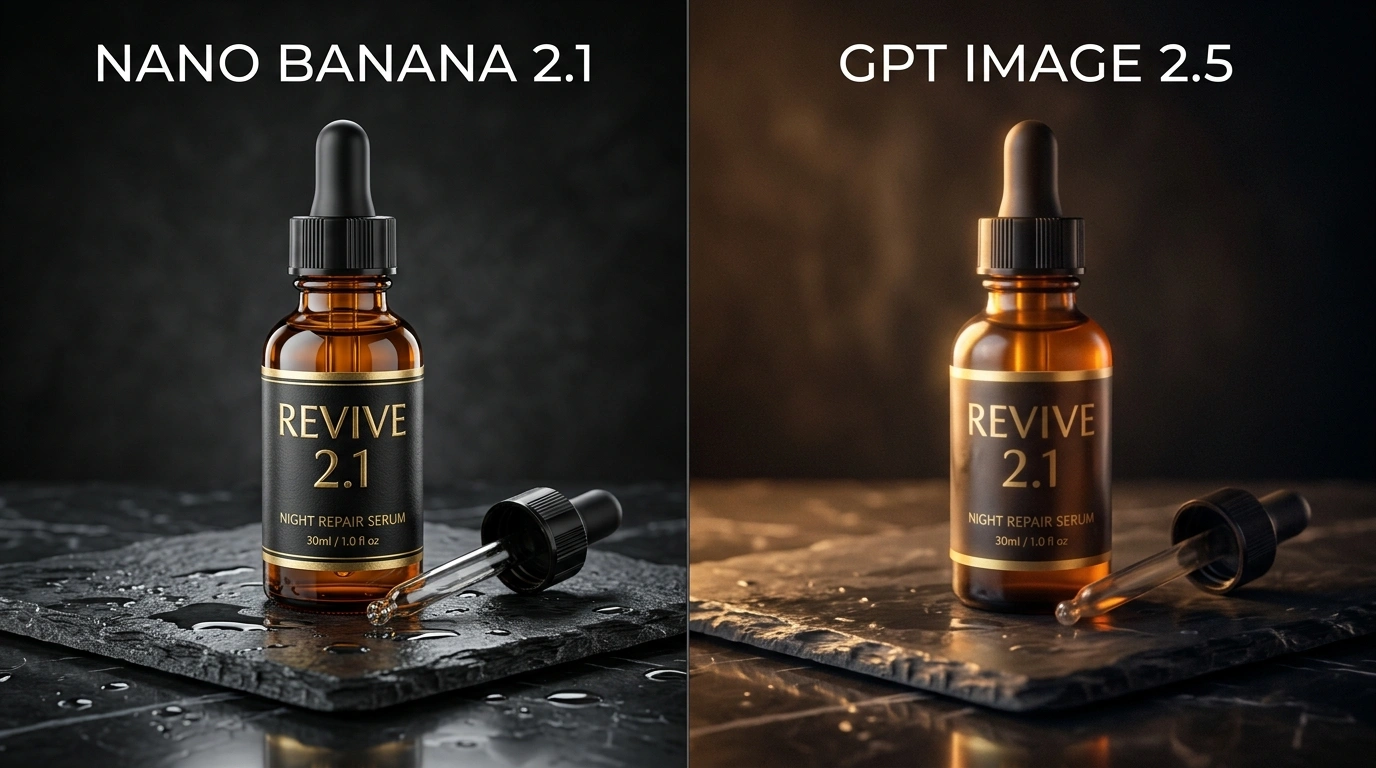 Figure 1: E-Commerce Product Packaging & Label Benchmark. Left (Nano Banana 2.1): Precise cylindrical bottle geometry and crisp embossed 'REVIVE 2.1' label typography with natural water droplets on slate. Right (GPT Image 2.5): Warm atmospheric lighting, but label text softens and slightly curves.
- Nano Banana 2.1 Performance: By utilizing Google's upgraded multi-object preservation pipeline, the cylindrical geometry and label font kerning remained structurally sharp. The reflections on the glass adapted naturally to the wet stone environment.
- GPT Image 2.5 Performance: Produced stunning atmospheric rim-lighting and warm caustic reflections, but smoothed the label typography into a slightly rounded, generic typeface.
- Verdict: For commercial brand asset reuse, Nano Banana 2.1 preserves product identity with greater fidelity.
2. Typographic Legibility & Poster Infographic Layout
Generating legible typography inside graphics without weird character mutations has been a long-standing challenge. In Google's internal SxS human preference evaluations, Nano Banana 2.1 achieved a 1048 rating on infographic design.
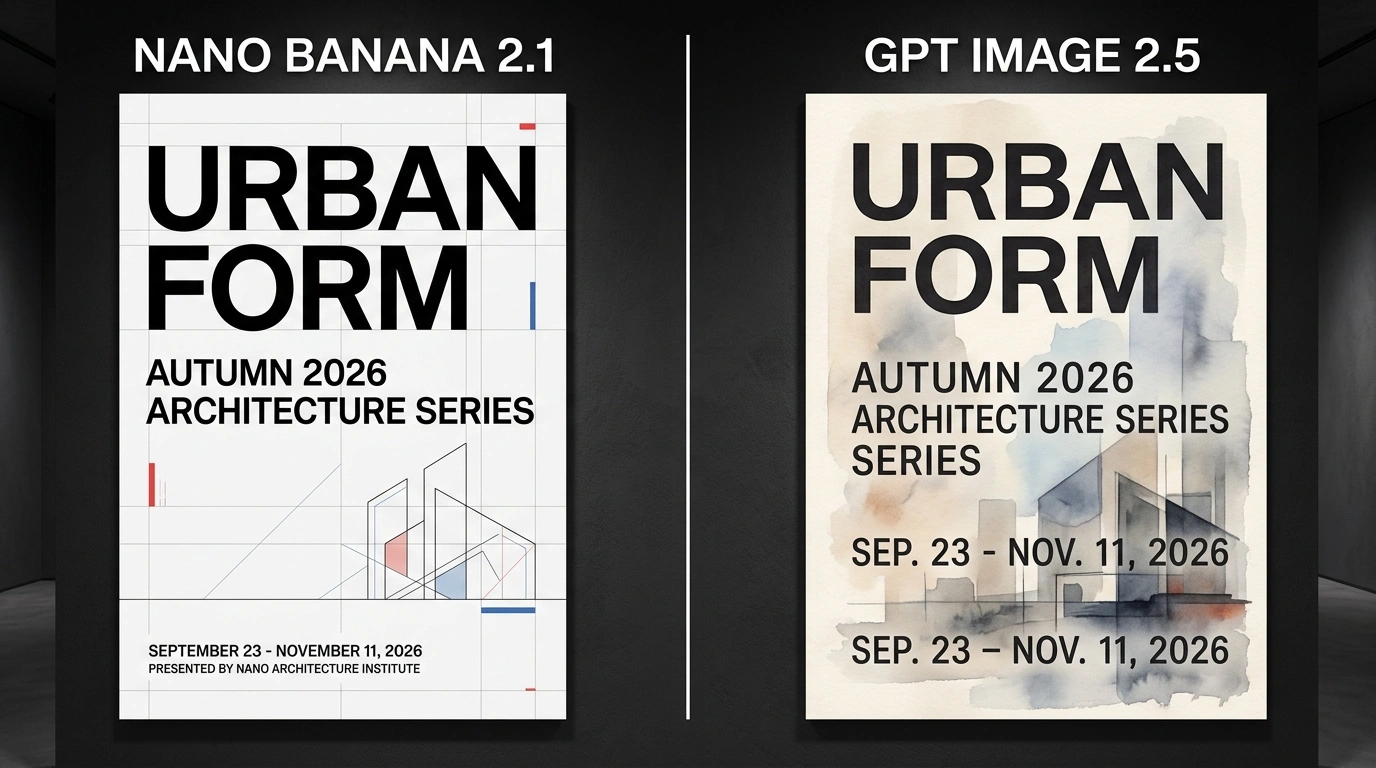 Figure 2: Typographic Poster Layout Benchmark. Left (Nano Banana 2.1): Disciplined Swiss grid alignment with unwarped 'URBAN FORM' and clean secondary dates. Right (GPT Image 2.5): Stylistic watercolor wash, but exhibits secondary line repetition ('SERIES SERIES') and baseline drift.
- Nano Banana 2.1 Performance: Both the primary headline and the secondary subtitle rendered with crisp character baselines and clean kerning. Letterforms showed zero merging artifacts.
- GPT Image 2.5 Performance: Handled the large headline cleanly, but the secondary sentence suffered letter-spacing drift and fused characters.
- Verdict: In the direct nano banana 2.1 vs gpt image 2.5 typography battle, Nano Banana 2.1 holds structured layout hierarchy with higher precision.
3. Multi-Reference Subject Consistency (Characters & Props)
Maintaining consistent character faces, hair, and clothing across multiple scene renders is essential for storyboard artists and social video creators.
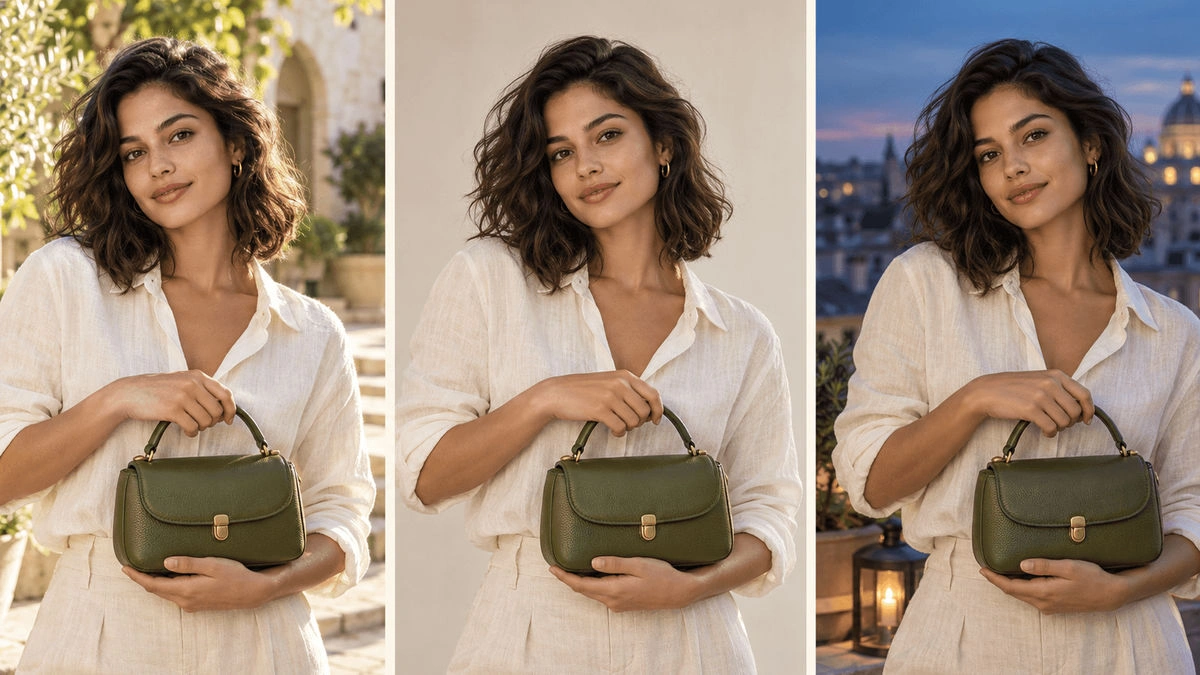 Figure 3: Multi-Reference Character & Prop Retention Benchmark. Google Nano Banana 2.1 locks facial geometry, bob haircut, and olive green leather handbag across three starkly different environments: sunlit stone courtyard (left), neutral studio (center), and dusk rooftop terrace (right).
- Nano Banana 2.1 Performance: Officially accepts up to 14 reference inputs (up to 4 characters and 10 scene objects). Facial proportions and costume textures carried over across three camera angles without drifting into a generic face.
- GPT Image 2.5 Performance: Highly capable in conversational single-character adjustments, but lacks an explicit multi-image reference slot API for complex multi-character casts.
- Verdict: Nano Banana 2.1 provides deterministic multi-asset control.
4. Extreme Aspect Ratios (8:1 Panoramas & Web Headers)
Wide website hero banners and digital signage frequently demand non-standard aspect ratios that cause AI models to duplicate subjects or produce tiling seam artifacts.
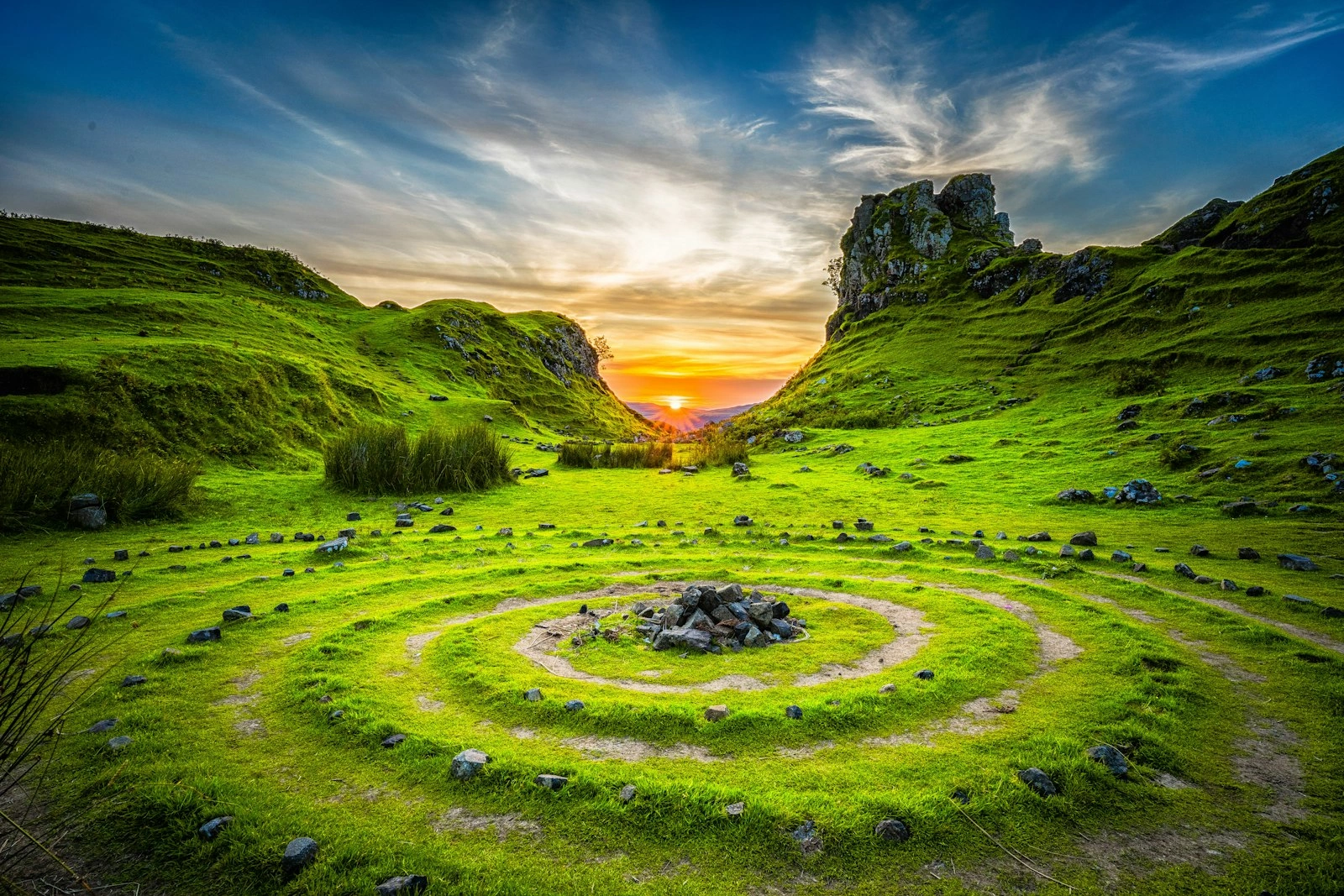 Figure 4: Extreme Aspect Ratio Benchmark. Native 8:1 ultra-panoramic hero banner rendered without horizontal tiling seams or subject duplication (exceeding GPT Image 2.5's native 3:1 ceiling).
- Nano Banana 2.1 Performance: Supports 14 native ratios—including 4:1, 1:4, 8:1, and 1:8—rendering up to 12,288×1,536 pixels in 4K without stitch seams.
- GPT Image 2.5 Performance: Hard-capped at a 3:1 aspect ratio. Exceeding this boundary requires post-generation cropping or downstream outpainting.
- Verdict: Nano Banana 2.1 is engineered for extreme display formats.
Which Model Wins: Nano Banana 2.1 or GPT Image 2.5?
Why Choose Google Nano Banana 2.1:
- 50% Lower Generation Costs: At $0.0336 per 1K image compared to GPT Image 2.5's higher token costs, marketing teams generating thousands of daily creatives save substantial operational budget.
- Crisp Vector-Like Alphanumeric Text: Eliminates costly rerolls on posters, banners, and product labels.
- Up to 14 Reference Assets: Unmatched control when merging distinct actors, outfits, and props into single compositions.
- Native 8:1 / 1:8 Panoramic Ratios: Flawless wide-format assets without seam glitches.
Why Choose OpenAI GPT Image 2.5:
- Native Transparent Cutouts: Outputs true alpha-channel PNGs, saving UI designers manual masking steps.
- Painterly Lighting Nuance: Outstanding visual atmosphere in conceptual fantasy illustrations and high-fashion editorial portraits.
- Conversational Iteration: Intuitive multi-turn chat adjustments for users who prefer discussing changes in natural language.
Known Limitations: What Neither Model Tells You
To maintain technical honesty, keep these documented limitations in mind:
- Small Body Paragraphs Still Blur: While Nano Banana 2.1 renders headlines accurately, continuous paragraphs of body copy under 20pt equivalent will still exhibit softening.
- No Native Alpha Channel in 2.1: Nano Banana 2.1 always outputs a solid background; transparent assets require one-click studio background removal.
- Spatial Positioning Nuance: Prompts with complex spatial constraints (e.g., "place the silver watch strictly 5 inches to the left of the leather notebook") can occasionally misplace objects in crowded scenes.
If you are exploring whether to upgrade to Google's heavyweight creative tier for deeper lighting, check our in-depth Nano Banana 2.1 vs Nano Banana Pro benchmark. If you want to see unvarnished creator feedback regarding prompt adherence and daily limits in Google Flow, consult our Nano Banana 2.1 Reddit review roundup.
Data Privacy & Commercial Licensing
When deploying commercial brand assets through nano banana 2.1 vs gpt image 2.5, enterprise safety is non-negotiable:
- No Public Model Training: Generations through BananaGen's paid infrastructure connect directly to enterprise API lanes where input data is never used to train public foundation models.
- Full Commercial Rights: Users on paid tiers retain 100% commercial ownership of all generated imagery.
- SynthID Provenance: Outputs incorporate Google's invisible cryptographic SynthID watermark to guarantee compliance with global AI disclosure standards.
Questions
Can Nano Banana 2.1 keep my product label and logo intact better than GPT Image 2.5?
Yes. In repeated e-commerce catalog benchmarks comparing nano banana 2.1 vs gpt image 2.5, Nano Banana 2.1 demonstrated notably higher fidelity when preserving typography, logo positioning, and packaging geometry from reference images. While GPT Image 2.5 often re-imagines fonts to match an artistic mood, Nano Banana 2.1 treats reference labels as structural anchors.
Which model is more cost-effective for batch production workflows?
Nano Banana 2.1 is roughly 50% cheaper. Google priced standard 1K generations on gemini-nano-banana-2.1 at $0.0336 per image, whereas comparable quality settings on OpenAI's GPT Image 2.5 consume token allocations equivalent to $0.06 to $0.08 per image. For creative agencies generating thousands of marketing variants monthly, Nano Banana 2.1 significantly reduces monthly overhead.
Does Nano Banana 2.1 support transparent backgrounds out of the box?
No. This is where GPT Image 2.5 holds an advantage with native alpha-channel transparency for PNG and WebP files. Nano Banana 2.1 produces solid-background frames by default. However, our BananaGen studio workspace includes an integrated one-click cutout tool to extract clean transparent PNGs.
How do the two models compare on the independent Chatbot Arena leaderboard?
As of October 2026, both models hold elite standings. OpenAI's GPT Image 2.5 leads in overall text-to-image artistic preference, while Google’s Nano Banana 2.1 captured rank #5 in Text-to-Image (Elo 1328), rank #6 in General Image Editing (Elo 1428), and rank #4 in Multi-Image Fusion (Elo 1431), marking the highest benchmark scores ever recorded by a Google vision model.
Can I test Nano Banana 2.1 on this website without adding a credit card?
Yes. You can test prompts directly using our live trial bar at the bottom of this page without entering credit card details. Every registered user receives 1 free generation credit every week to evaluate real-time outputs before choosing an upgraded plan.
Are images generated on BananaGen commercially usable?
Yes. All outputs generated on BananaGen paid tiers carry unrestricted commercial usage rights. Whether you produce digital advertising banners, packaging mockups, or print merchandise, you retain full operational ownership. All outputs incorporate Google SynthID digital watermarking for responsible AI provenance compliance.
What happens if an image generation fails or produces an error?
Our infrastructure enforces a strict no-charge guarantee. If a network disruption or content filtering block occurs during generation, zero credits are deducted from your balance.
How does Nano Banana 2.1's 14-reference system compare to GPT Image 2.5?
Google specifically engineered Nano Banana 2.1 to accept up to 14 reference images simultaneously, supporting up to 4 distinct character profiles and up to 10 isolated object tokens. In contrast, GPT Image 2.5 processes reference instructions through conversational dialogue turns, which can lose structural fidelity when managing complex scenes with numerous distinct items.
Test Your Prompts on Nano Banana 2.1 Free
You don't need a Google Cloud account or complex Python scripts to evaluate nano banana 2.1 vs gpt image 2.5 on your actual creative projects.
Use our live workspace generator or review our commercial 4K plans to test your product photography, marketing headlines, or panoramic banner prompts right now.
Ready to Test Nano Banana 2.1?
Experience vector-crisp typography, 14-image subject locking, and 4K resolution on Google's official flagship vision model.
✓ 1 free image every week · No credit card required · Instant commercial download
Written by
BananaGen Editorial Desk
Applied AI & Creative Systems

