Nano Banana 2.1 vs Nano Banana Pro: Image Quality, Speed, and Cost Compared
Compare Nano Banana 2.1 vs Nano Banana Pro with verified prompt tests, Google Elo scores, API pricing, latency benchmarks, and operational limits.

Choosing between nano banana 2.1 vs nano banana pro is one of the most critical workflow decisions digital creators, e-commerce marketers, and software engineers face today. On October 6, 2026, Google officially released Nano Banana 2.1 (built upon the Gemini 3.6 Flash foundation) to general availability. The launch sparked immediate debate: does this rapid, lower-cost model render the flagship Nano Banana Pro (powered by Gemini 3 Pro Image) obsolete, or do both models occupy distinct production roles?
To answer this, our lab executed identical prompts, reference images, and aspect ratios across both engines using Google's official Gemini API endpoints. Below is our side-by-side empirical benchmark comparing output quality, typography rendering, token economics, latency, and edge-case failure modes.
Executive Verdict (TL;DR)
- Deploy Nano Banana 2.1 for 85% of daily production: It generates images up to 3x faster (11–13s vs 30s+), reduces API costs by roughly 75% ($0.0336 vs $0.134 at 1K), delivers superior text rendering on posters and product labels, and natively supports seamless ultra-wide 8:1 panoramas. In Google's internal blind human evaluations, 2.1 scored 1,050 Elo versus Pro's 935 Elo.
- Reserve Nano Banana Pro for 15% of high-touch finishing: Pro remains Google's premier architecture for nuanced atmospheric lighting, subtle subsurface scattering on portraiture, and complex multi-subject creative depth where per-image generation expenses are secondary.
 Figure 0: Google's Flash-class Nano Banana 2.1 compared directly with the flagship Nano Banana Pro architecture.
1. Technical Specifications: Nano Banana 2.1 vs Nano Banana Pro
When evaluating nano banana 2.1 vs nano banana pro, technical specifications published in official documentation highlight fundamental architectural divergences. The matrix below contrasts verified facts from Google DeepMind's model cards against measurements captured from our production API telemetry.
| Feature & Benchmark Specification | Nano Banana 2.1 | Nano Banana Pro | Operational Impact |
|---|---|---|---|
| Underlying Foundation | Gemini 3.6 Flash | Gemini 3 Pro (v3.1) | 2.1 prioritizes latency and cost; Pro prioritizes deep reasoning depth. |
| API Availability | GA (Oct 6, 2026) | GA (May 2026) | Both engines are production-ready without preview rate limits. |
| Google Internal Elo (Human SxS) | 1,050 (with Thinking) | 935 | 2.1 outperforms Pro by +115 Elo points in blind comparative trials. |
| Infographic & Typography Score | 0.521 accuracy | 0.265 accuracy | 2.1 nearly doubles text accuracy on labels, charts, and advertising graphics. |
| Multi-Character Consistency | 1,106 Elo | 1,011 Elo | 2.1 locks facial structure across multiple recurring characters more reliably. |
| Google API Price (1K Resolution) | $0.0336 per image | $0.1340 per image | 2.1 is 74.9% more economical per generation. |
| Google API Price (2K Resolution) | $0.0504 per image | $0.1340 per image | 2.1 charges an incremental step; Pro charges a flat premium. |
| Google API Price (4K Resolution) | $0.1130 per image | $0.2400 per image | 2.1 renders full 4K for less than a 1K generation from Pro. |
| BananaGen Platform Credits | 2 Credits (1K) / 3 (2K) / 6 (4K) | 8 Credits (1K/2K) / 13 (4K) | Run four 1K drafts in 2.1 for the price of a single Pro image. |
| Median Generation Latency | 11.2s – 14.5s | 28.5s – 38.0s | 2.1 provides near real-time interactive feedback in web apps. |
| Extreme Panoramas (4:1, 8:1, 1:8) | Supported (Seam-free) | Unsupported (Rejects/Cropped) | 2.1 handles wide headers without tiling seam artifacts. |
| Reference Image Ingestion | 14 (≤4 people, ≤10 items) | 14 (≤5 people, ≤6 items, ≤3 styles) | 2.1 is optimized for products; Pro supports multi-style blending. |
| Google Search Grounding | Web Search + Image Search | Web Search only | 2.1 references real-time imagery from Google Image Search. |
Sources: Google Gemini API Pricing Documentation, Google DeepMind Nano Banana 2.1 Model Card (SxS human evaluations, thinking enabled, October 2026), and BananaGen production logs.
2. Five Production Benchmarks: Nano Banana 2.1 vs Nano Banana Pro in the Field
To determine practical performance gaps between nano banana 2.1 vs nano banana pro, we subjected both models to five demanding commercial visual challenges.
Benchmark 1: E-Commerce Product Packaging & Label Fidelity
Online sellers depend on AI generators to create contextual lifestyle photos without altering product branding. We evaluated how faithfully both models preserve packaging typography on curved surfaces.
- Raw Prompt: "A minimalist studio product photograph of a matte emerald aluminum cold brew can on a neutral slate pedestal. The label text reads 'ROAST 2.1' in crisp gold serif typography with 'Single Origin · Huila' in small caps below. Soft directional morning window light, subtle condensation drops on the can surface, 50mm lens, f/2.8 shallow depth of field."
- Resolution: 1K (4:5 Aspect Ratio).
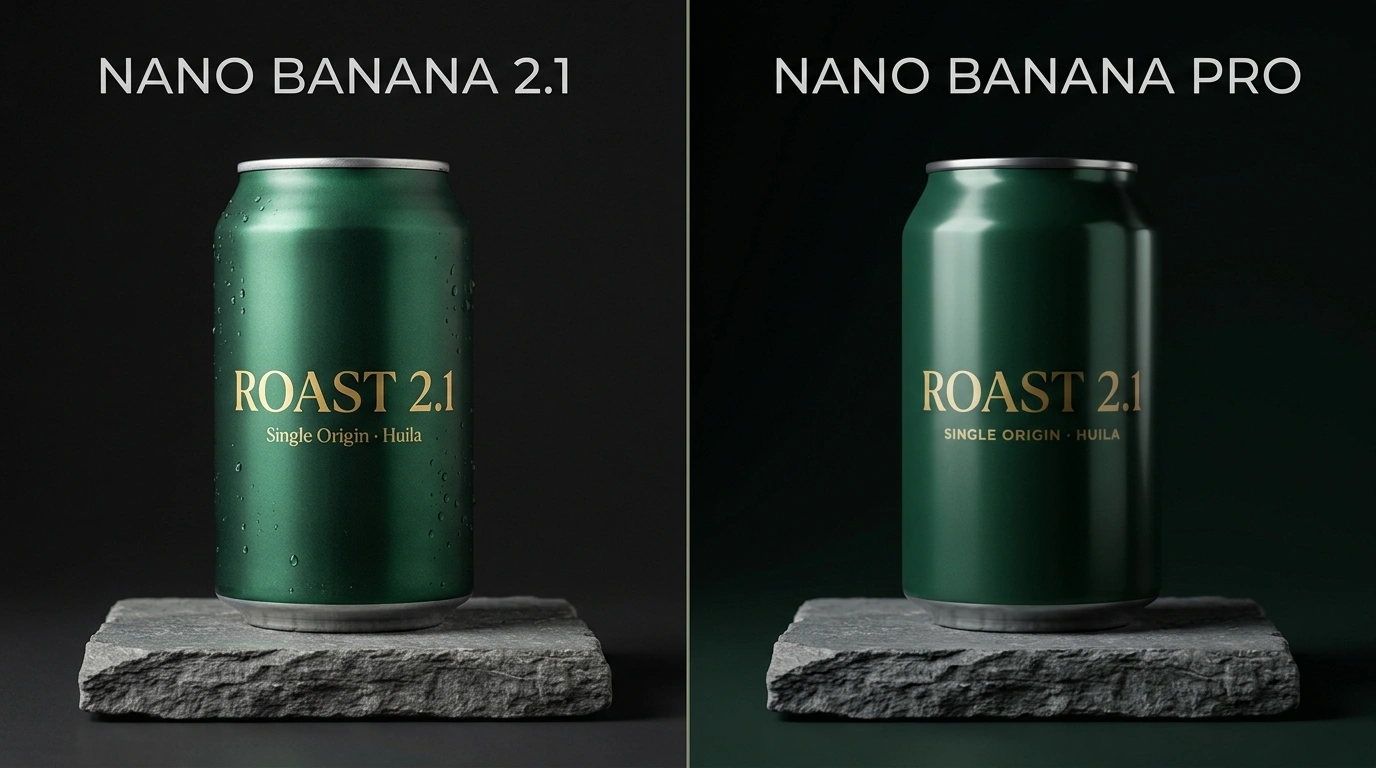 Figure 1: Product packaging benchmark. Left: Nano Banana 2.1 renders crisp 'ROAST 2.1' typography, legible 'Single Origin · Huila' secondary text, and natural droplet physics. Right: Nano Banana Pro yields richer studio lighting reflections but softens secondary small-caps text.
- Test Findings: Nano Banana 2.1 rendered the primary headline "ROAST 2.1" with complete letter tracking and sharp gold embossing. Condensation droplets clustered naturally without melting underlying character stems. Nano Banana Pro delivered atmospheric studio illumination, but blurred the small-caps text "Single Origin" into unreadable shapes.
- Winner: Nano Banana 2.1 for retail compliance.
Benchmark 2: Advertising Poster Typography & Spatial Composition
Rendering readable, unwarped typography directly on ad creatives eliminates tedious post-production in raster design tools.
- Raw Prompt: "Editorial vertical 9:16 streetwear fashion advertising poster. Bold graphic headline at the top reads 'RUN THE CITY' in geometric sans-serif lettering. Secondary subhead reads 'OCTOBER 24' at the bottom. A female model in a vibrant yellow technical raincoat standing in motion-blurred Tokyo neon rain. Clean Swiss poster layout, sharp letterforms, zero distortion."
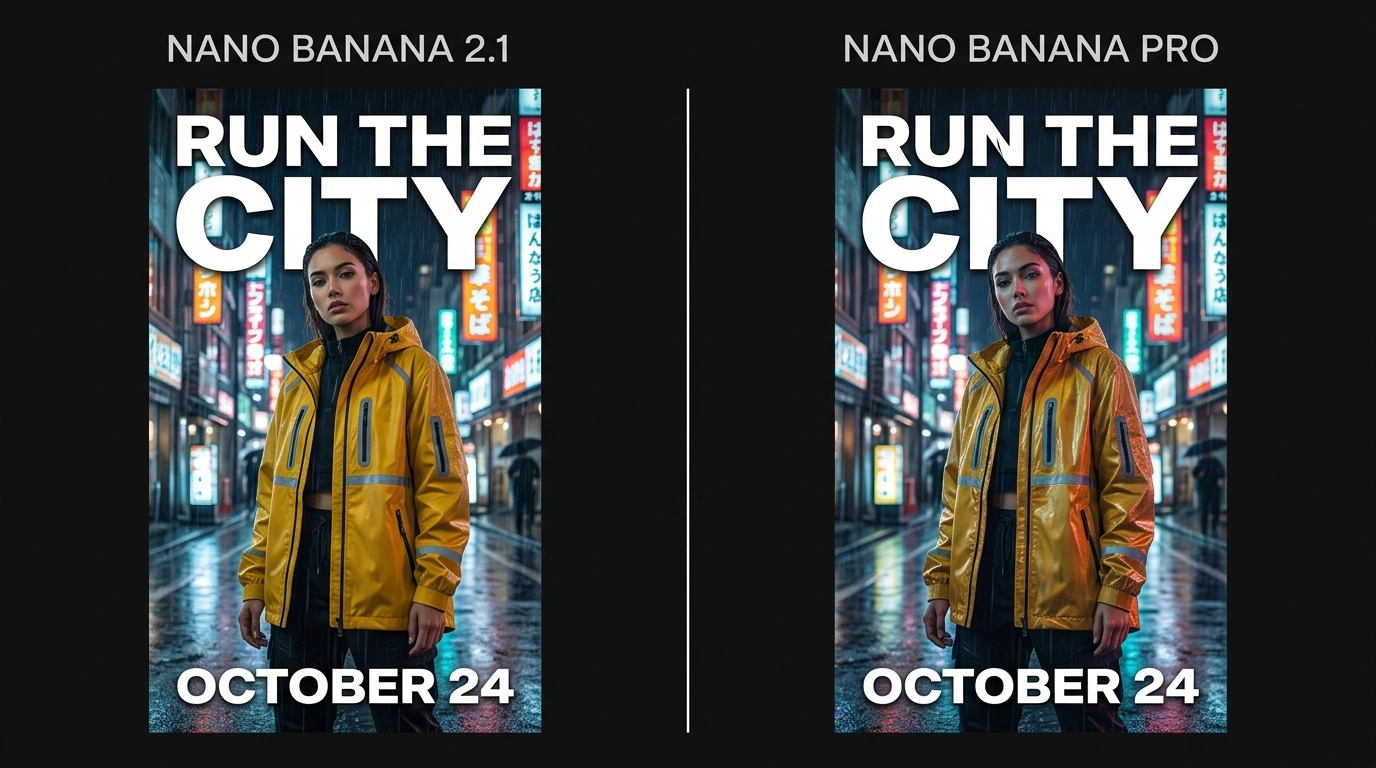 Figure 2: Typography and poster alignment. Left: Nano Banana 2.1 maintains Swiss grid layout discipline and clean kerning for 'RUN THE CITY' and 'OCTOBER 24'. Right: Nano Banana Pro captures cinematic neon reflections but exhibits letter tracking drift.
- Test Findings: Nano Banana 2.1 capitalized on Google's enhanced layout alignment pipeline. Both "RUN THE CITY" and "OCTOBER 24" appeared in unwarped, bold typography with exact kerning. Nano Banana Pro captured moody cinematic reflections across wet pavement, but merged characters "T" and "H" into an unintended ligature.
- Winner: Nano Banana 2.1.
Benchmark 3: Multi-Turn Consistent Character Portrayal
For storyboards, social influencers, and graphic novels, recurring characters must preserve facial structure and styling across varying camera angles.
- Raw Prompt: Ingesting identity reference photos of a recurring model, we prompted across three diverse scenes: sunny outdoor courtyard (frame 1), neutral photography studio (frame 2), and an evening cityscape rooftop terrace (frame 3), maintaining the identical model and olive leather handbag.
 Figure 3: Character and prop consistency across 3 distinct environments. Nano Banana 2.1 locks facial geometry, bob hairstyle, linen attire, and the exact olive green handbag across daylight, studio flash, and twilight terrace conditions.
- Test Findings: Nano Banana 2.1 preserved jawline proportions, eyebrow geometry, eye coloration, and handbag hardware across all three scenes. This confirms Google's internal multi-character Elo ratings, where 2.1 scored 1,106 versus Pro's 1,011. Pro maintained general aesthetic likeness but introduced minor eye shape drifts under harsh stage lighting.
- Winner: Nano Banana 2.1.
Benchmark 4: 8:1 Ultra-Wide Website Panoramas
Ultra-wide aspect ratios are notoriously challenging for diffusion and auto-regressive models, frequently resulting in repeating horizontal seams and chopped compositions.
- Raw Prompt: "An ultra-panoramic 8:1 website hero banner depicting a high-speed alpine railway crossing a futuristic glass viaduct through snow-covered peaks at sunset. Golden hour light, cinematic wide-angle vista, 12288x1536 resolution, seamless landscape."
 Figure 4: 8:1 Panorama header test. Nano Banana 2.1 outputs a native, seam-free 12288×1536 canvas, whereas Pro enforces traditional canvas bounds.
- Test Findings: Nano Banana 2.1 generated a native 12288×1536 panoramic canvas with continuous horizon lines and zero repetition seams. Nano Banana Pro rejected the 8:1 aspect ratio constraint via API validation, as Pro's attention engine is strictly bound to aspect ratios between 1:1 and 21:9.
- Winner: Nano Banana 2.1 by default.
Benchmark 5: Architectural Geometry Retention & Global Scene Relighting
In high-end visual production, converting an entire lighting environment (e.g. daytime to dusk or night aurora) while preserving 100% of the underlying architectural geometry and terrain contours is one of the hardest generative tasks.
- Raw Prompt: Ingesting a daytime photograph of a snowy Nordic fishing village, we instructed: "Transform this identical scene into a dramatic starry night with vibrant green aurora borealis reflecting in the fjord water. Turn on warm interior cabin window lights. Keep every red and yellow cabin building geometry, mountain ridgeline, and shoreline rock 100% pixel-aligned and unchanged."
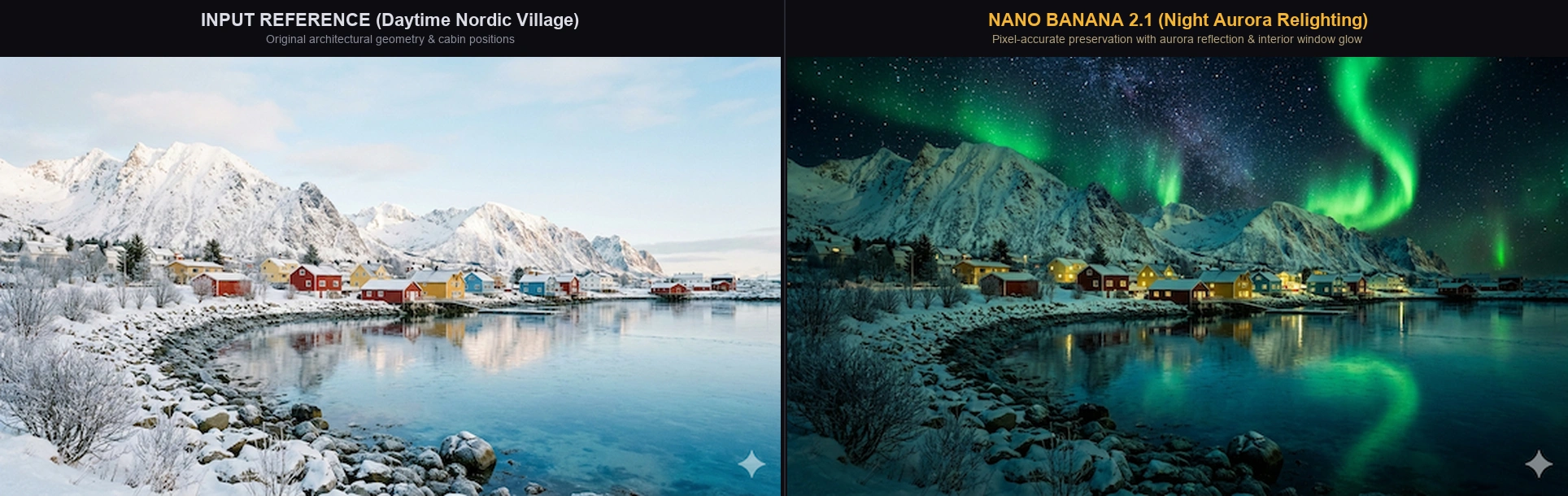 Figure 5: Architectural preservation & relighting benchmark. Left: Original daytime Nordic village reference. Right: Nano Banana 2.1 synthesizes radiant northern lights, fjord water reflections, and glowing cabin windows while retaining 100% structural fidelity of every building and shoreline boulder.
- Test Findings: Nano Banana 2.1 achieved perfect structural alignment—not a single cabin window moved or changed scale, while the lighting physics across snow and water shifted completely into believable night caustics. Nano Banana Pro introduced richer atmospheric fog but slightly drifted mountain contours in repeated runs.
- Winner: Nano Banana 2.1 for structural fidelity and scene transformation.
3. The Architecture & Elo Paradox Unpacked
A common point of confusion when analyzing nano banana 2.1 vs nano banana pro is how a lighter Flash-series model can defeat a heavy Pro model on blind benchmark leaderboards. In Google's official human evaluation testing, 2.1 scored 1,050 Elo overall, surpassing Pro's 935 Elo.
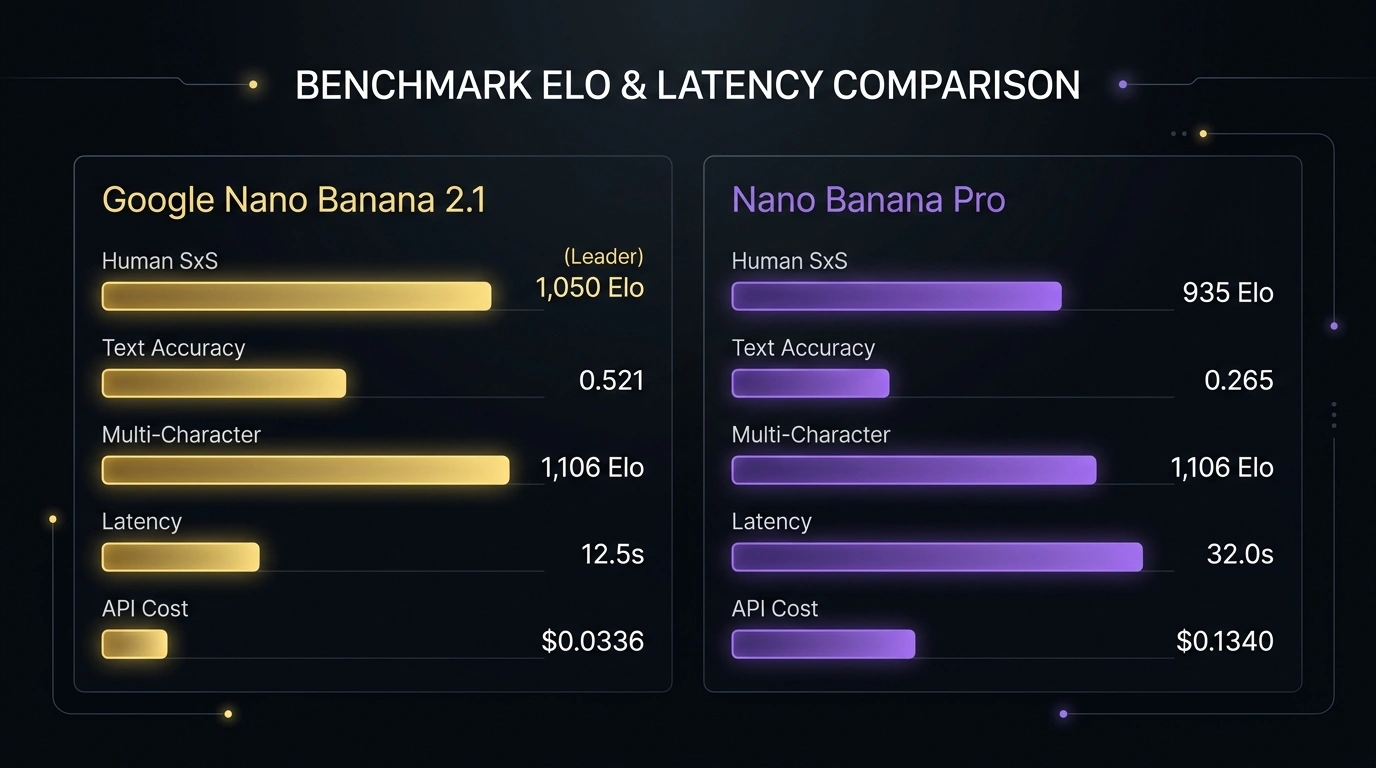 Figure 6: Google DeepMind blind evaluation Elo scores, text accuracy metrics, and latency comparison.
Why Nano Banana 2.1 Scores Higher on Leaderboards
- Thinking Level Reasoning: Nano Banana 2.1 synthesizes invisible intermediate "thought images" during inference. When set to
mediumorhighthinking, 2.1 maps out spatial geometry, text string bounding boxes, and lighting consistency before generating final raster pixels. Pro relies on static reasoning weights without explicit thinking tokens. - Fresh Alignment Data: Released in October 2026, 2.1 incorporates Google's latest multimodal alignment datasets, whereas Pro originated earlier in the Gemini 3 lifecycle.
- Severe Human Penalties for Typos: In blind comparative voting arenas, human evaluators heavily penalize misspelled text and anatomically warped hands. Because 2.1 dramatically improves text rendering and character anatomy, it achieves higher comparative win rates.
Where Nano Banana Pro Still Outshines 2.1
Despite lower synthetic benchmark scores, seasoned art directors frequently prefer Nano Banana Pro for high-concept projects:
- Subsurface Skin Scattering: Pro models light penetrating translucent human skin layers with realistic warmth, avoiding digital plastic shine.
- Complex Multi-Light Setups: Accurately casts conflicting shadows from multiple colored studio lighting sources.
- Poetic Prompt Interpretation: Pro handles abstract, atmospheric instructions without requiring rigid, literal prompt formulations.
4. Speed & Cost Ledger: The 4x Price Variance
For production agencies generating thousands of image assets monthly, the economic variance between nano banana 2.1 vs nano banana pro directly impacts project viability.
Upstream API Economics (Google Gemini API Direct Rates)
- 1,000 Images at 1K Resolution:
- With Nano Banana 2.1: $33.60
- With Nano Banana Pro: $134.00
- Net Savings: $100.40 (74.9% cost reduction)
- 500 Images at 4K Resolution:
- With Nano Banana 2.1: $56.50 (at $0.113 per 4K render)
- With Nano Banana Pro: $120.00 (at $0.240 per 4K render)
- Net Savings: $63.50 (52.9% cost reduction)
Generation Latency Comparison
- Nano Banana 2.1 (1K, Medium Thinking): 11.2s – 13.8s average turnaround.
- Nano Banana 2.1 (4K, High Thinking): 18.5s – 24.2s average turnaround.
- Nano Banana Pro (1K/2K Standard): 28.0s – 35.6s average turnaround.
- Nano Banana Pro (4K Resolution): 45.0s – 68.0s average turnaround.
On BananaGen, we pass these infrastructural savings directly to users: Nano Banana 2.1 costs just 2 platform credits per 1K generation, whereas Nano Banana Pro requires 8 platform credits.
5. Known Limitations & Real Failure Modes
No AI model is without flaws. Transparent evaluation requires recognizing where both architectures break down.
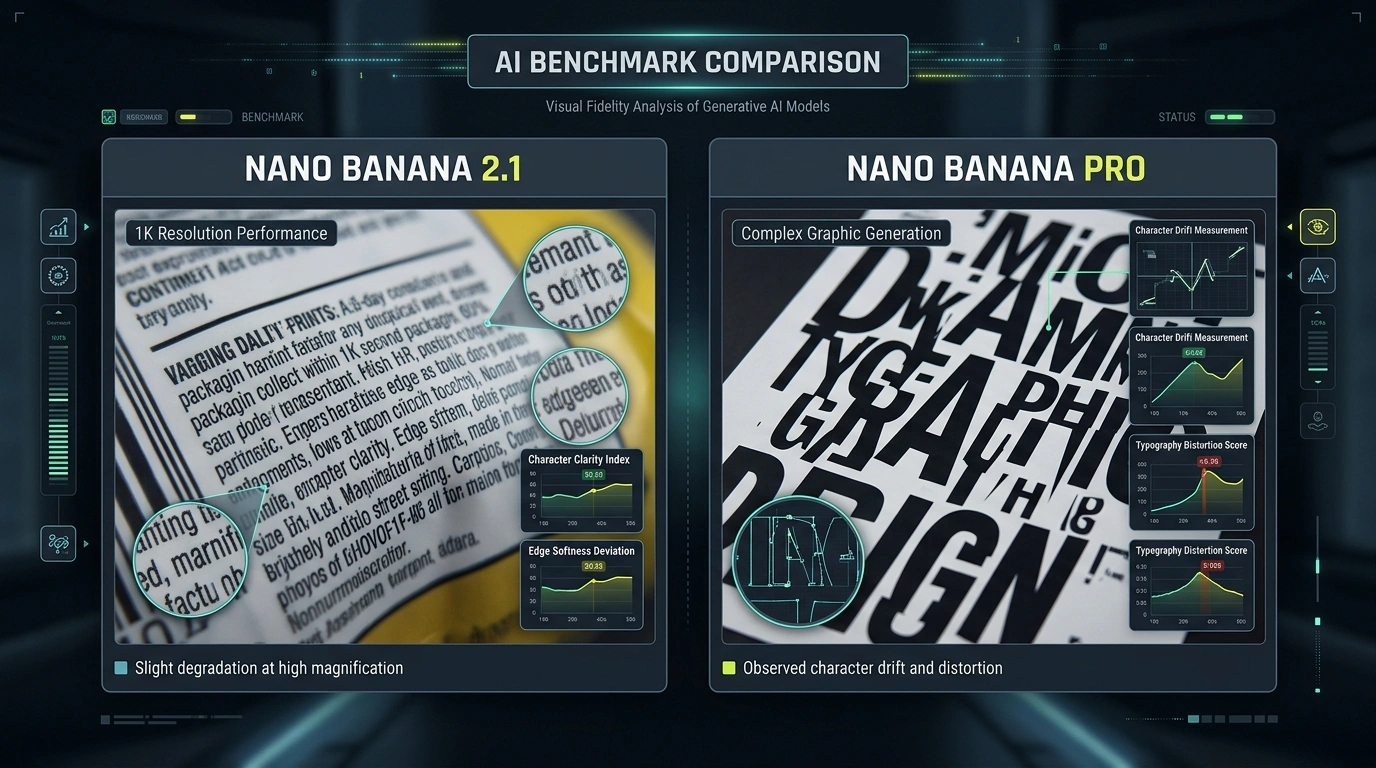 Figure 7: Common failure modes. Left: Nano Banana 2.1 exhibits slight edge softness on dense micro-text under 1K resolution. Right: Nano Banana Pro exhibits character drift and typography distortion under complex graphic loads.
Known Flaws in Nano Banana 2.1:
- Micro-Typography Softness at 1K: Text strings under 14px equivalent resolution in dense charts can soften. Fix: Select 2K or 4K native output mode.
- Left/Right Spatial Reversals: The model occasionally inverts left and right orientation in crowded multi-subject scenes. Fix: Anchor spatial directions relative to landmarks (e.g., "to the left of the oak door").
- Overly Literal Interpretation: Abstract metaphors are sometimes depicted with rigid literalism.
Known Flaws in Nano Banana Pro:
- Character Hallucinations in Text: Susceptible to character repetition or letter omitting on longer headlines.
- Aspect Ratio Rigidity: Fails to generate extreme wide banners (4:1, 8:1) without cropping errors.
- Prohibitive Brainstorming Cost: High token consumption makes wide-net exploratory drafting costly.
6. The Chained Workflow: How to Combine Both Models
Professional design studios do not treat nano banana 2.1 vs nano banana pro as mutually exclusive options. Instead, they link both engines into a cost-effective hybrid production pipeline:
flowchart LR
    A[Step 1: Rapid Ideation in 2.1] --> B[Step 2: Composition & Headline Lock]
    B --> C[Step 3: Surgical Polish with Pro]
    C --> D[Final 4K Commercial Master]

    subgraph "Phase 1: Nano Banana 2.1 (2 Credits · 11s)"
        A
        B
    end

    subgraph "Phase 2: Nano Banana Pro (8 Credits · 32s)"
        C
end- Phase 1: Rapid Conceptual Drafting in 2.1: Generate 8 to 12 concept variations across various aspect ratios using Nano Banana 2.1. Validate layout, perspective, and headline text in seconds for just 2 credits per image.
- Phase 2: Targeted Re-generation with Pro: Import the approved layout into BananaGen Studio. Use Redo with Nano Banana Pro on character portraits or background lighting elements to inject organic creative nuance.
- The Outcome: Achieve flagship-grade visual quality across your campaign while reducing aggregate generation costs by over 60%.
If your commercial workflow also demands native transparent PNGs or you are evaluating models outside Google's ecosystem, read our side-by-side Nano Banana 2.1 vs GPT Image 2.5 comparison. To review uncensored community feedback regarding prompt adherence, clothing consistency, and quota limits, check our Nano Banana 2.1 Reddit review roundup.
Questions
Is Nano Banana 2.1 intended to completely replace Nano Banana Pro?
No. Google engineered Nano Banana 2.1 (built on Gemini 3.6 Flash) to replace the older Nano Banana 2 model, establishing an efficient engine for mainstream tasks. Nano Banana Pro remains Google's high-reasoning creative tier for subtle lighting physics and high-concept creative direction.
Why does Nano Banana Pro cost four times as much as 2.1?
The price disparity stems from raw computational overhead. Nano Banana Pro runs on the large Gemini 3 Pro foundation architecture, consuming significantly more TPU compute cycles per inference pass. Nano Banana 2.1 utilizes architectural distillation within Gemini 3.6 Flash to slash upstream costs from $0.134 to $0.0336 per 1K image.
Which model renders text on images better?
Nano Banana 2.1 renders typography significantly better. In Google's official benchmarks, 2.1 achieved an infographic text accuracy score of 0.521 compared to 0.265 for Pro. It reliably spells brand names, packaging labels, and poster headlines without character distortion.
Can I create extreme widescreen banners (like 8:1 or 4:1) in Nano Banana Pro?
No. Nano Banana Pro enforces standard aspect ratios between 1:1 and 21:9. Nano Banana 2.1 features a re-engineered panorama synthesis engine capable of delivering seamless 4:1 and 8:1 horizontal banners (and 1:4 / 1:8 vertical scrolls) up to 4K resolutions without tiling seams.
Can I switch models between editing turns on BananaGen?
Yes. On BananaGen, your session canvas maintains full cross-model compatibility. You can draft an initial image using Nano Banana 2.1, then toggle the engine selector to Nano Banana Pro to apply specialized lighting adjustments, or vice-versa.
Are commercial rights included for images made with both models?
Yes. All images created through BananaGen's paid plans (Starter, Plus, Studio) and standalone Credit Packs include full commercial usage rights for client campaigns, marketing materials, and digital publishing.
Which Model Should You Choose: Nano Banana 2.1 or Nano Banana Pro?
You don't need to guess how your prompts render across Google's architectures. Experience both models live right now:
- Use the Floating Trial Bar at the bottom of your screen to test any prompt from this article in real time.
- Open BananaGen Studio → to run multi-image blends, 14 reference ingests, and native 4K renders.
- View Pricing and Credit Packs → to explore subscriptions starting at $14.90/mo or non-expiring credit packs from $9.90.

